

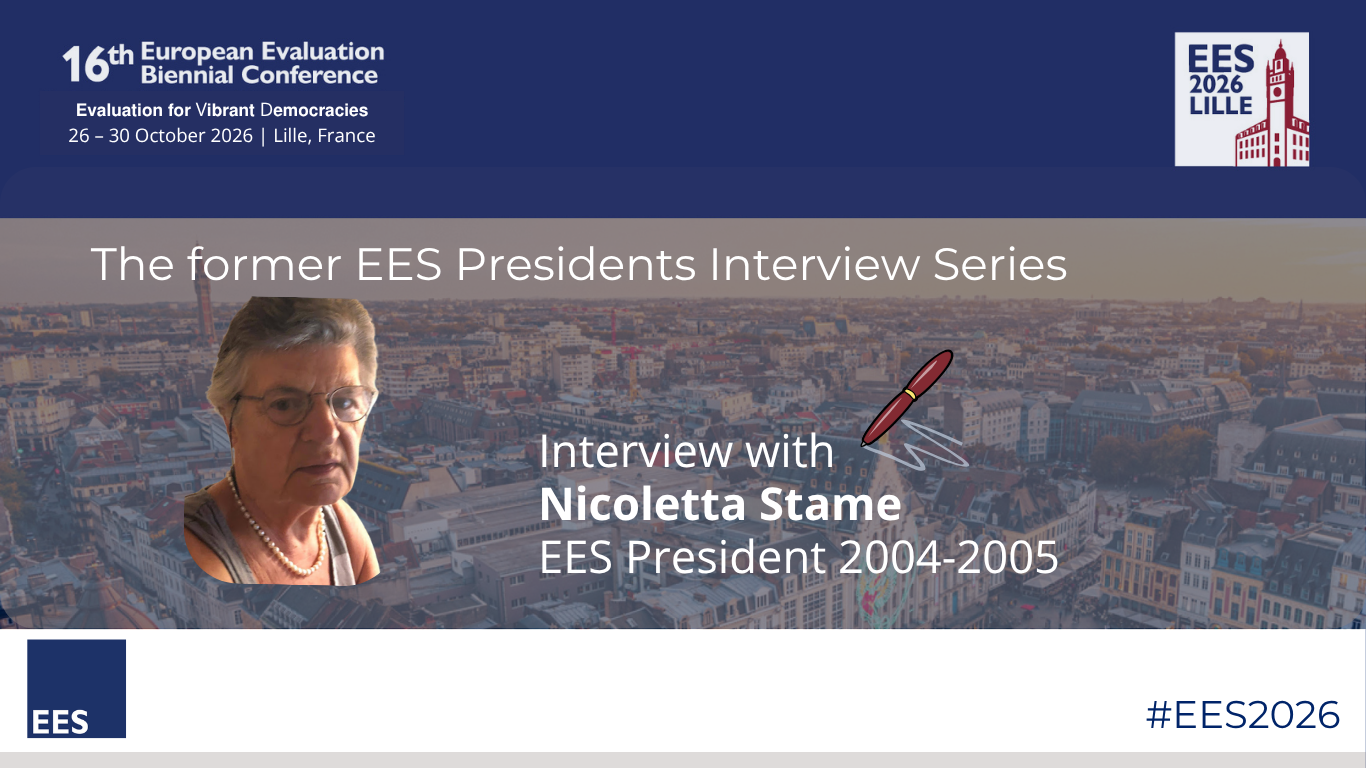
In this new interview series, EES President Peter van der Knaap speaks with former EES presidents about their current work, reflection on their time leading the Society, the evolution of evaluation practice, and the opportunities and challenges facing the profession today. They also share their perspectives on the upcoming EES conference theme, Evaluation for Vibrant Democracies, and offer advice to the next generation of evaluators. In this interview, Peter speaks with Nicoletta Stame, EES President from 2004-2005, about her current work, reflections on leading the Society, and her views on the future of evaluation.
What are you currently working on?
My activity takes place mainly within A Colorni-Hirschman International Institute, a group that keeps alive the intellectual legacy of two great thinkers (the philosopher Eugenio Colorni, 1909-44, and the social scientist Albert Hirschman, 1915-2013) by applying their “possibilist” theory to personal experience.
I keep being interested in evaluation approaches and their link to democratic theory and practice. For a long time, I have worked on what made different approaches converge on a path that favored empowerment, development, change. That was my intention when I compared theory-based approaches, or positive thinking approaches. In this exercise little by little I added to the better-known approaches the perspective of “possibilism”, as practiced in evaluation by Judith Tendler (1938-2016). Then I felt the need for a step forward, i.e. “Thinking like a possibilist”, which helped me in addressing themes like “ethics broadly speaking” and “change as it happens”. In this new phase of my work, I was helped by the study of the thought of Eugenio Colorni: his insistence on doubt and surprise, his idea of the link between science and morality, his privileging “understanding” over “explaining” and fresh ideas over models, are a guide of my current work.
Democracy should not be seen as an add-on to evaluation practice, but as its core. This means that it should be the prism through which all what belongs to the evaluation field (both practice and theory) is assessed. With this motivation, together with Maria Bustelo and other colleagues, we have co-authored a book on commissioning and the chances of its being acted democratically. I hope this work can stimulate a reflection among practitioners and thinkers.
When were you EES President, and what are the key changes in our field and their context?
I was President in 2004-2005, the time of the Berlin EES Conference.
At that moment European evaluation was more concerned with EU programs, and there was a growing interest in institutionalization and professionalization.
The main change I witness is the widening of the areas of intervention (more policies than programs; not aiming at specific outcomes/impact but at general orientations, like sustainability or equity and other SDGs) and the protagonism of new subjects, as in decolonizing approaches.
This outlines the need for evaluation to adapt its tools to the new situation. While complexity and system are hardly new themes, what matters is to keep our practice open to grasp what is novel, and to forge innovative tools that build on the core elements of our democratic inspiration.
The theme of the upcoming EES conference is ‘Evaluation for vibrant democracies’; what is your personal connection to this?
As will be clear from the above, I strongly support this theme. Even if I would have approved it on a general basis, I consider it more than suited to the current international situation, where attacks to democracy are widespread, and their effects on evaluation activities clearly felt.
What are vibrant democracies? It is not only a matter of constitutional settlements, or respect for the rule of law. It is also a matter of the inner working of social and economic activities, where the people involved should be able to react to autocratic tendencies finding alternatives in the opportunities offered by contexts, traditions and ways of thinking that evaluation could reveal.
We live in turbulent times with much change, including technological change: what do you see as the biggest challenges and opportunities for evaluation?
Perhaps because I belong to the old generation, I am not an enthusiast of the use of AI in evaluation. Not that I dismiss the ability with which it performs tasks of data collection and analysis, although I am aware of the limitations coming from the way machines have been instructed.
But my interest for “understanding” and observing on the field, building on the tacit knowledge of the people and their local thinking, not to speak of the native spirituality so dear to decolonizing evaluators, make me think that there is a whole world of activity outside the reach of AI that evaluators should concentrate on. From this point of view, evaluators should be grateful to AI for allowing them to spend more time in primary research.
What should the priorities for the EES be in the coming years?
Focus on whatever is able to contrast the autocratic turn in all the spheres of the evaluation process, from management to use. Infuse in evaluators and other concerned people a sense that by their own agency they can contribute to improve the situation.
Finally: what ‘wise advice’ would you like to offer to young and emerging evaluators?
In the Colorni-Hirschman Institute we invite people to be “rebel and competent”: “rebel” toward all constraining rules of the game and received knowledge that are presented as matter of fact, “competent” in elaborating sound arguments for a better world. This in my view well adapts to emerging evaluators reflecting on their motivation and experience.