

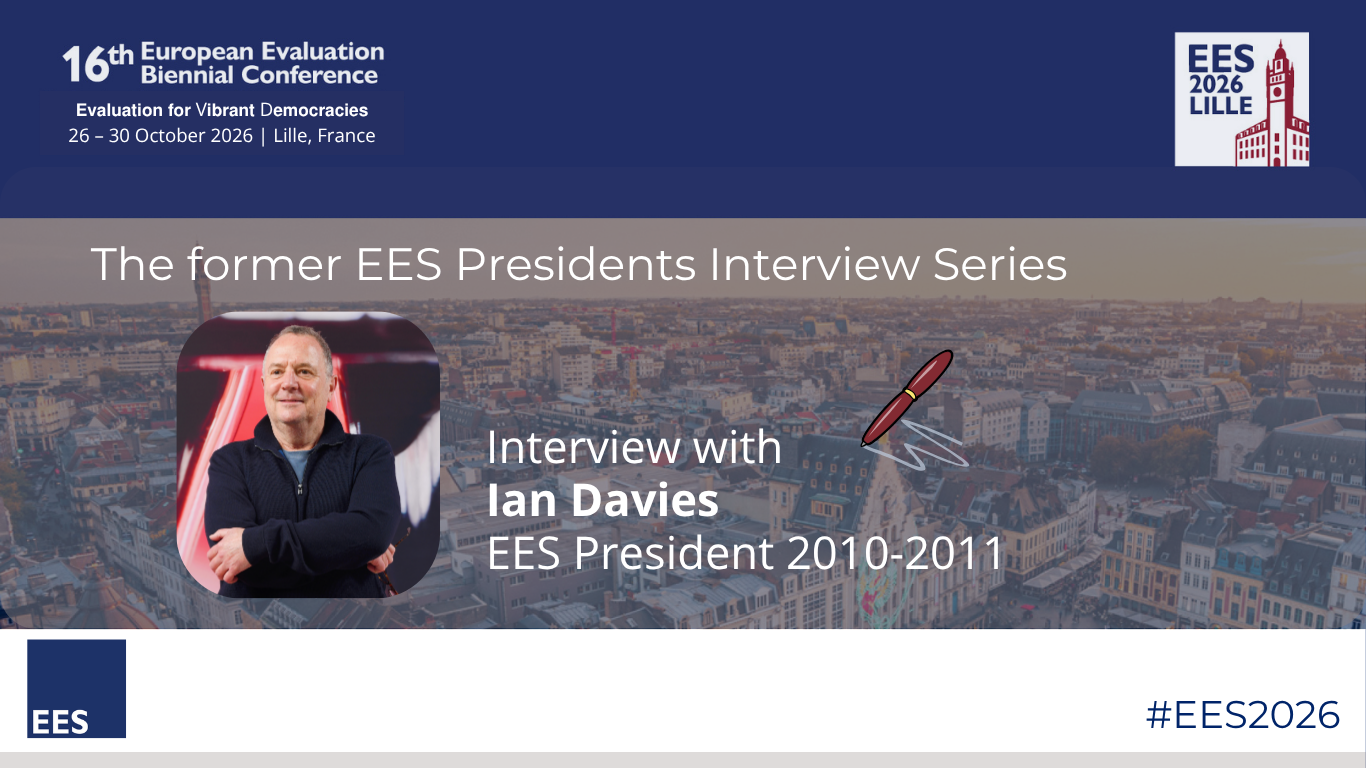
In this new interview series, EES President Peter van der Knaap speaks with former EES presidents about their current work, reflection on their time leading the Society, the evolution of evaluation practice, and the opportunities and challenges facing the profession today. They also share their perspectives on the upcoming EES conference theme, Evaluation for Vibrant Democracies, and offer advice to the next generation of evaluators. In this interview, Peter speaks with Ian Davies, EES President from 2010-2011, about his current work, reflections on leading the Society, and his views on the future of evaluation.
What are you currently working on?
I am leading an evaluation for a major UN agency in partnership with a large African foundation, on the renewal of a global prize for Peace. In addition, I am supervising four postgraduate evaluation students who are completing their thesis.
When were you EES President, and what are the key changes in our field and their context?
I was EES President in 2010 and 2011. Since then there has been an exponential increase in people presenting themselves as evaluators, of which a significant portion – as I see it – does not have the minimum required competencies. Also, I notice a diminishing interest in questions of professionalisation of evaluation.
There is an overall shift away from ‘valuing’ to ‘measuring’ achievement of results and from addressing fundamental questions such as epistemic justice, to focussing almost exclusively on methods. In addition, I see a standardisation of ‘evaluation’ processes, particularly in the international multilateral and bilateral systems, to the point where ‘evaluation’ could be carried out in large part by AI.
More importantly, in the context of an increasing offer and a diminishing demand for evaluation, there is an existential risk to evaluation as a valuing and learning craft.
Fortunately, however, there is still some healthy critical thinking in the field although it is rarely found in mainstream institutional evaluative theory and practice.
The theme of the upcoming EES conference is ‘Evaluation for vibrant democracies’; what is your personal connection to this?
They key issue in my view is that of epistemic justice, which mainstream institutional evaluation essentially ignores. Democracy is not only about individuals and communities, but as well the preservation, recognition and celebration of different world views, their voices and wisdom. Epistemic justice is foundational to decolonisation, dismantling exploitation and dominant systems of oppression.
We live in turbulent times with much change, including technological change: what do you see as the biggest challenges and opportunities for evaluation?
The biggest challenge is for evaluation to break out of its self-constructed and self-imposed gilded neo-liberal cage. The opportunities reside in doing away with results-based madness and obsessive measurement disorder, return to evaluation’s fundamental valuing and learning function, focus on the quality of processes for sustainability, survival and quality of life for humans, starting with the most oppressed.
What should the priorities for the EES be in the coming years?
- Engage with other disciplines, i.e., stop being inward looking.
- Get evaluation’s head out of the toolbox, deal with big picture and pressing issues of our time.
- Engage publicly on salient policy and political issues.
- Demonstrate and show daring, creative, outspoken, critical (and constructive), leadership in professional and public (political) spheres. Call out injustices, engage, use the power of evidence, challenge, show what needs to be addressed and dealt with.
Finally: what ‘wise advice’ would you like to offer to young and emerging evaluators?
See the above! 😉
Don’t go into evaluation if your main reason is to get a job and a reasonable prospect of a well-paid career path.
Go into it if you are passionate about its potential as a force for the good of humanity, if you are prepared to embark on a journey of lifelong learning, constant questioning, uncertain employment, never ending homework, blood, sweat and tears, and getting to know amazing people.