
In November 2024, Karina Lehrner and Yulye Jessica Romo Ramos joined Petra Novakova as co-leads to the EES thematic working group (TWG) 1, Equity and Gender. From the beginning, the three of us shared a strong commitment to equity, diversity and inclusion, not just concepts we talk about but values we want to role model and live by. This is why we decided to design and facilitate a deeply reflective and participatory process that would help the TWG 1 collectively shape its new identity and future direction, while modelling the type of reflective practice we seek to expand.
Our approach generated quite a lot of interest, so we decided to capture the journey undertaken so far, put it on paper and share it more widely via this blog. In doing so, we hope readers are inspired and supported in designing and facilitating processes that can create spaces for collective sense-making and co-creation.
For us, this is a journey, and one we want to travel in collaboration with others. So please reach out if you want to discuss this approach in more detail or if you have any feedback!
1. We used purpose and remit-focused questions to frame the inquiry:
-
- How could TWGs make significant contributions towards evaluation excellence and influence in Europe and beyond?
- How do we collectively come together to create impact?
- How do we balance all of the above with individual members’ needs?
2. We named non-negotiable beliefs:
-
- Equity, diversity, and inclusion (EDI) are essential to transform gendered power relations and redress historical injustices and power imbalances.
- Feminist and gender-transformative evaluation approaches require the evaluation sector and multiple actors in an ecosystem of power hierarchies, such as philanthropy and entities like EES, to address power and positionality issues to contribute to positive impact for all.
- Structures of inequality and exclusion manifest in every context, from North to South, and across a range of public, private and non-profit programmes and institutions and even ourselves. We aim to surface these challenges with responsiveness to local realities wherever they occur.
3. We identified three main areas of interest/influence:
-
- The EES itself: its capacity, representation and positionality
- TWG members: their expertise, knowledge and needs
- The wider sector: other evaluation spaces, as well as the wider community of philanthropy and donors.
4. We facilitated a series of group discussions with a wide range of TWG 1 members, EES board members and evaluators not part of our TWG. These took place during 10 months.
-
- Initial discussions focused on the above-mentioned framing questions, beliefs and areas of influence. Our main focus was to evaluate our use of language and process, to understand whether people thought these were useful, resonated with them or what else we might be missing in creating and advancing collective reflection and voice.
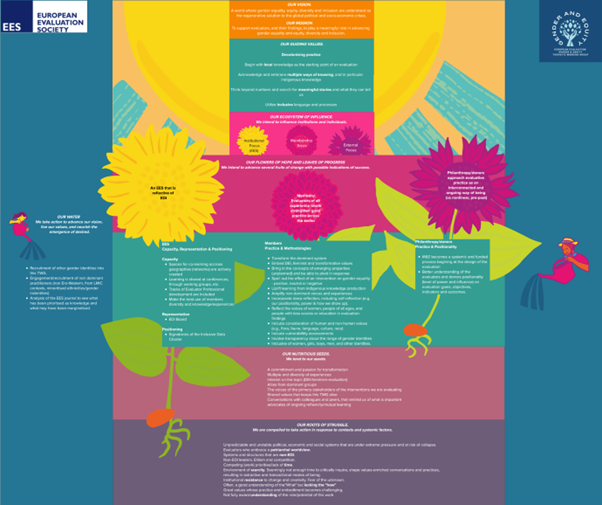
- Other sessions were focused on unearthing and reflecting on a wider set of dimensions, including key issues and systemic factors; our collective assets and specific actions we could pursue under each of the identified areas of influence. To do that, we used a garden metaphor and visual framework that enabled collective conversation and affirmation (see figure below).
- Our very last session was used to present the fruits of these deeply reflective and collective efforts, using a final version of our visual framework. And on identifying which areas we should prioritise in the first year and which we will work on later. We also discussed that it would serve as a reflective tool for ongoing alignment and adaptation, supporting a dynamic and intentional process.
5. We developed a new logo as the previous one no longer suited our new identity and focus.
-
- We created a survey with three logo options, which was circulated for a vote, alongside opportunities for respondents to suggest improvements to their preferred logo.
- The most voted logo, with minor adjustments, was chosen.
6. We committed to using our new logo, vision, mission, values and actions to guide our operational plan and to help us evaluate and adapt as we advance the work in subsequent years. We desire to do this collectively, furthering the participatory and inclusive process we initiated and nurtured.
The following visual is a summary of our collective aspirations, values and lived experience. It outlines our new identity, purpose and action plan.
“I learned a lot through this process, which was a bonus for me, in addition to better understanding how we can best serve our thematic group members and make a positive contribution to the evaluation sector more widely”, Yulye J. Romo Ramos.
What is next?
Most people participating in these discussions were interested in prioritising membership-related work and support. We have consistently heard a desire to better understand key concepts and what they look like in practice, as well as what the business case is for feminist and equitable evaluation practice. This is why we organised a webinar with Nur R. Hidayati and Susan Bergson, guest speakers who bring over 20 years of experience each in these issues.
In addition to the above, Yulye is also working closely with the EES board. The EES board asked her to design a process for an EDI-informed strategy, which was well-received, and Yulye has agreed to help them implement it.
So, watch the space and please join our TWG if you are interested in being part of this community, and reach out to any of us directly if you have any questions or suggestions!
Warm wishes,
Yulye, Karina and Petra
Co-leads, TWG 1 – Equity and Gender