

Date/Time
Date(s) - 11/06/2026
14:00 - 15:30
Categories
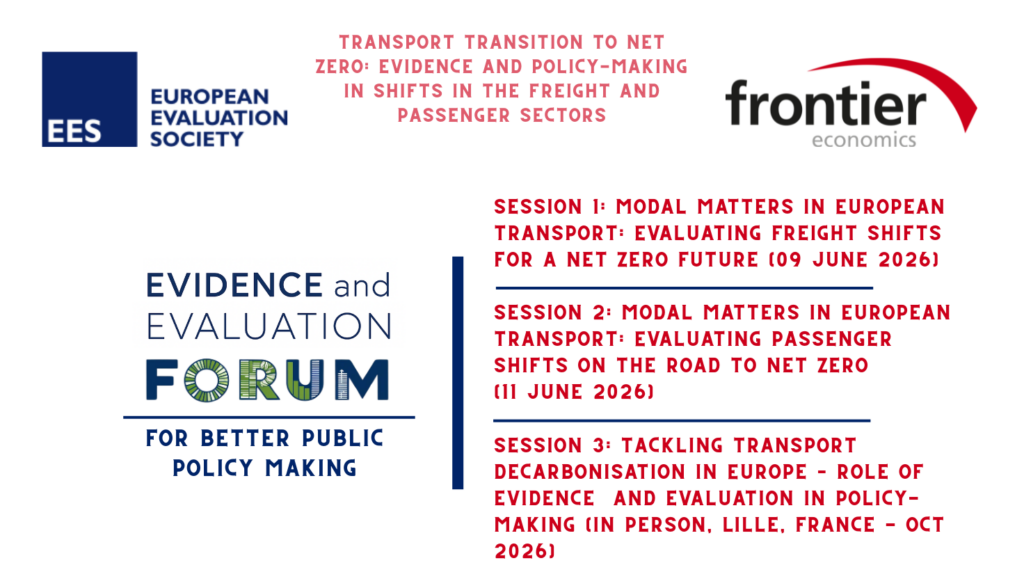
Date: Thurs 11 June 2026
Time: 13:00 BST/ 14:00 CEST / ⏱ 90 minutes
Price: Free to attend
Venue: Online via Zoom
Chair: Catherine Galano, Executive Director, Head of Paris Office, Frontier Economics
Event Details
The European Green Deal and the Sustainable and Smart Mobility Strategy set ambitious objectives to shift passenger transport away from high-emission modes (private car, short-haul aviation) toward lower-emission alternatives (rail, public transport, cycling, walking). Yet progress remains uneven and, in many Member countries across Europe, too slow.
The evidence review underpinning this event highlights:
- Strong evidence clusters in certain areas (congestion charging, parking pricing, cycling infrastructure, bus priority corridors)
- More limited or short-term evidence for fare reductions and integrated ticketing
- Significant evaluation gaps concerning:
- Long-term behavioural retention
- Distributional impacts
- Transferability beyond dense urban contexts
- Robust counterfactual designs
While many passenger modal shift policies are politically visible and widely replicated, fewer are backed by strong causal evidence on sustained emissions impact.
This session will:
- Take stock of robust evaluation evidence on passenger modal shift policies across Europe.
- Identify interventions which demonstrate durable behavioural change rather than short-term effects.
- Examine methodological challenges, including counterfactual design and linking mode shift to emissions outcomes.
- Discuss transferability across countries and governance contexts.
Speakers:
We are privileged and delighted to welcome the following leading experts to this session:
Professor Greg Marsden

Professor Greg Marsden is Professor of Transport Governance at the Institute for Transport Studies, University of Leeds. His research examines how governance structures and policy design influence sustainable transport outcomes and behavioural change. He has extensive experience evaluating transport interventions, including those aimed at reducing energy demand and supporting place-based decarbonisation. Through major UK research programmes, he explores integrated technological and social transitions in mobility systems. His work brings a strong evaluation perspective to understanding what drives effective and durable modal shift.
Professor Maria Börjesson

Professor Maria Börjesson is Professor of Economics at VTI, Swedish National Road and Transport Research Institute and an Adjunct Professor at Linköping University, specialising in transport economics and public policy design. Her research focuses on how pricing, taxation, infrastructure investment, and regulatory measures shape transport systems and behavioural responses. She has produced extensive empirical evidence on modal choice, climate impacts, and cost-efficient pathways to achieve transport decarbonisation targets. Her recent work includes advanced modelling of travel behaviour and policy impacts using large-scale data. She brings a rigorous analytical perspective on the effectiveness and distributional impacts of modal shift policies across Europe.
Dr. Camilo Franco

Dr. Camilo Franco is an expert in transport and environment at the Climate Neutrality, Energy and Mobility Unit in the European Environmental Agency (EEA). He is responsible for the annual report on the sustainability of EU’s mobility systems 2025, under the Transport and Environment Reporting Mechanism, monitoring the trends and outlook for the transport sector on specific topics such as activity and demand, energy use and infrastructure, GHG emissions and air/noise pollution. He has extensive expertise in evidence-based assessment, linking research, policy, and progress towards climate and energy targets.
Book your tickets
To book your tickets to attend this free event, you will need to register in advance of the event via Zoom by clicking here.