

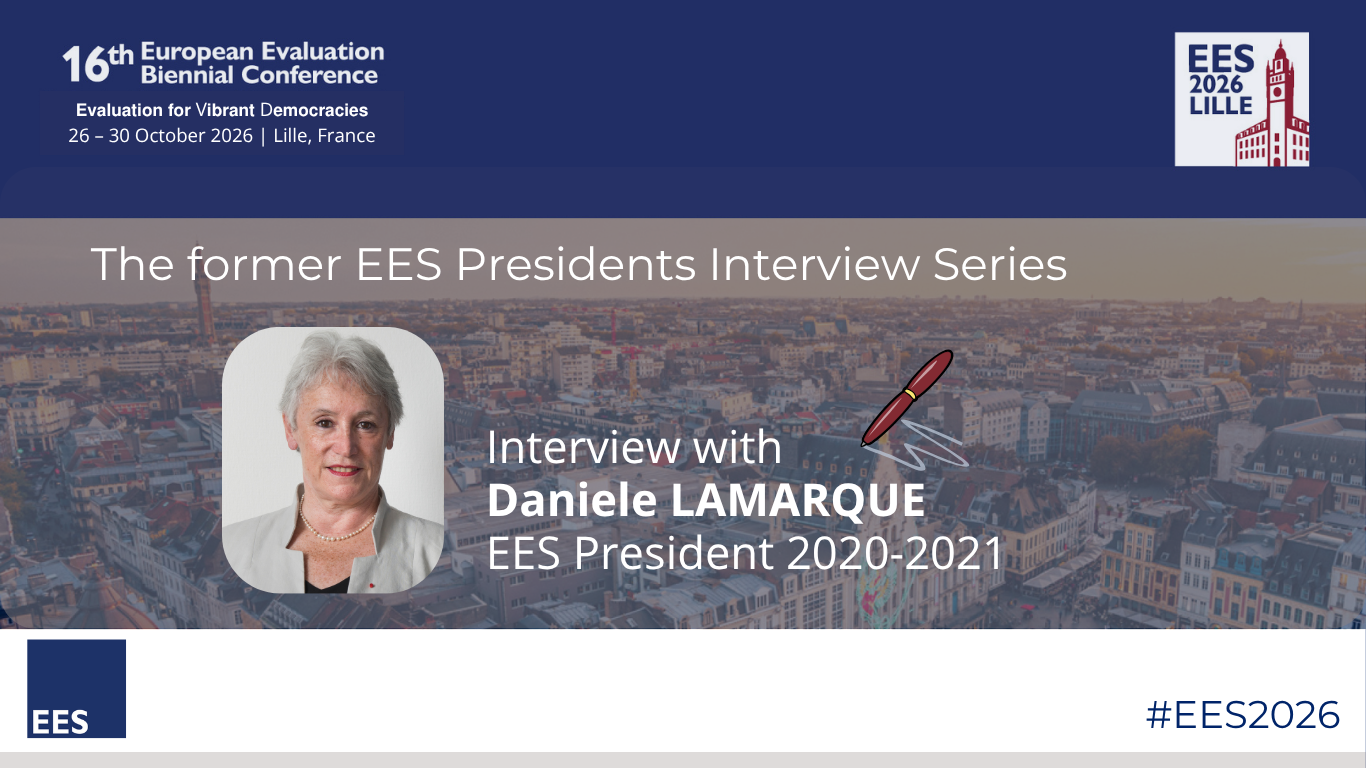
In this new interview series, EES President Peter van der Knaap speaks with former EES presidents about their current work, reflection on their time leading the Society, the evolution of evaluation practice, and the opportunities and challenges facing the profession today. They also share their perspectives on the upcoming EES conference theme, Evaluation for Vibrant Democracies, and offer advice to the next generation of evaluators. In this interview, Peter speaks with Daniele LAMARQUE, EES President from 2020-2021, about her current work, reflections on leading the Society, and her views on the future of evaluation.
What are you currently working on?
I have been appointed (August 2025) as an expert to the Public Aid to Development evaluation Committee. We face unprecedented stakes in the current climate of declining official aid and recipient countries’ expectations for more partnership-based approaches. Evaluators should consequently adapt their methods to take these expectations into account, develop appropriate approaches for shared public-private interventions and report on effective impacts.
When were you EES President, and what are the key changes in our field and their context?
I chaired EES in 2020 and 2021, during the difficult period of the COVID-19 pandemic, which led us to develop webinars and various online communication tools. Despite the difficulties we faced in holding our biennial conference, which has been postponed until 2022, the Covid-19 pandemic has provided an opportunity to revamp the EES’s relationship with its members and strengthen the community of evaluators.
The theme of the upcoming EES conference is ‘Evaluation for vibrant democracies’; what is your personal connection to this?
Now more than ever, we must ensure that evaluation – and, more broadly, knowledge – contributes to public decision-making and public debate.
We live in turbulent times with much change, including technological change: what do you see as the biggest challenges and opportunities for evaluation?
Evaluation should of course make use of new technologies such as AI. However, we expect evaluation to focus on its core values: assessing the impact of public policy, upholding the status of science and knowledge, and promoting rigorous and multidisciplinary approaches.
What should the priorities for the EES be in the coming years?
During my time in the EES board, as a president and after, I devoted a great deal of time to the European network of evaluation societies (NESE). I am convinced that one of the main contributions of EES is to facilitate communication between evaluators and strengthen our professional community.
Finally: what ‘wise advice’ would you like to offer to young and emerging evaluators?
Focus on approaches that help to understand why public interventions have failed or succeeded, and what benefits they bring to people.
Talk to colleagues from other countries.