

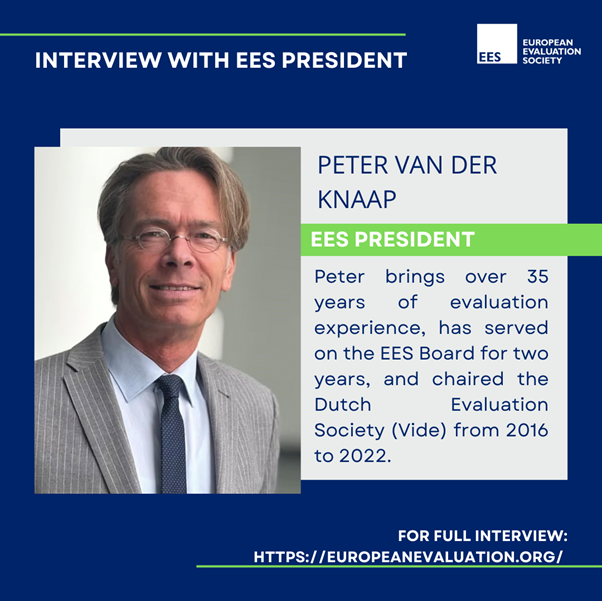
This month we welcome our new EES President, Peter van der Knaap, who has taken over the gavel from May Pettigrew.
Peter has been active on the EES board for two years, has over 35 years of evaluation experience and chaired the Dutch Evaluation Society ‘Vide’ from 2016 until 2022. He is looking forward to his new role: “It’s a true honour, but I also feel the responsibility in these challenging times.”
Read the full interview with our new President below.
Why did you decide to run for EES president?
In my work as an evaluation scholar and, later, evaluator, I’ve always found EES conferences enriching. And the people I came to know through the EES are both smart and fun to hang out with. So when I was approached to run for the board and subsequently for the chair of our wonderful society, I didn’t hesitate long: it’s a true honour to usher in a new phase for the EES.
But foremost, I feel the responsibility. I chaired the Dutch Evaluation Society from 2016 until 2022, so I also know it is hard work.
Let me take this opportunity to thank May Pettigrew for her leadership of the last two years. Together with Tom Ling and other board members, she made sure the EES can look forward to a bright future.
Is this a special moment to start?
Yes, I believe it is. We live in strange and, for many, difficult times. Geopolitically, Europe is facing many challenges, with increasing economic and political competition from just about everywhere and, of course, the ongoing war against Ukraine. Our democracies are under pressure. And the evaluator’s credo that knowledge can and indeed should improve policy and governance is no longer shared universally (to put it mildly).
On the positive side, Europe is lauded for being the exception that puts ‘human flourishing first’, which is both up for debate and something worth pursuing. And, with all the challenges, there are also good opportunities to fulfil the promise of professional evaluation as ‘a force for the good’. With a large membership and resources, I believe the EES is well-positioned to fulfil its mission. With gusto, preferably!”
You said you were present at the first EES conference, in The Hague, where you are based. What has changed since that time?
Look, our primary goal is still valid: to promote the theory, practice and utilisation of high-quality evaluation in Europe, and beyond. And I believe our deepest motivation continues to be a world where evaluation contributes to human welfare through knowledge, feedback, debate, and learning. Herein, values define what the EES is and stands for.
But these values are dynamic. Today, in addition to values around methodological quality, learning and accountability, and independence of evaluation research, they include diversity, equity, inclusiveness, and responsiveness. Our work must reflect that. There are really good responsive, participatory, and context-focusses approaches and methods out there and these enrich both data collection, analysis, and relevance. In my eyes, this does not mean abandoning quantitative methods or the quest for ‘good old’ cost-effectiveness evaluations. In the end, it all depends on the purpose of a particular evaluation. In fact, this pretty much sums up how I look at evaluation. There is no one ‘best approach’, there are just evaluation designs that fit well or do not fit well.
The new Board will start to update the EES strategy?
Yes – we believe it is about time. Both evaluation thinking and the way evaluation is organised in Europe and across the globe have matured. With the input from our members and working together with national evaluation societies, we want to develop a viable systems perspective strategy with structural partnerships that will allow us to be the ‘heart’ of a viable evaluation community in Europe.
We aim to provide better opportunities and platforms for innovation while providing a solid ‘knowledge and practice base’ for evaluators. Our longstanding combination of practice and theory – as reflected in our Evaluation Journal and in our Thematic Working Groups and initiatives like the Learning Hub and the Evidence and Evaluation Forum – allows for maintaining ‘pole position’ in this respect.
I also look forward to improving how the EES functions. By investing in targeted professional management support, a new website, and ways for an increased (institutional) membership involvement, we want to make sure the EES is well-run, value-for-money, and ready for the future. In this domain, too, all members will be invited to provide the board with your input and feedback.
How do you plan to do this?
We aim to adopt the new strategy at the Annual General Meeting of 2027. This month, we will discuss the first ideas in the new Board. We intend to start by listening very carefully to our members. We want to help individual and institutional members to face the challenges of these trying times and to grow professionally. Of course the best way to do that is to make sure that what we do is what our members need and want. We will share more information on the strategy process and how members can engage soon. But for those of you who read this and cannot wait: know how to find me! (Peter’s contact details are below.)
And then there is the 16th Biennial Conference…
This will provide another opportunity to engage in the new strategy! But yes, you are right: we are already working very hard to organise a fantastic conference in Lille, France, taking place from 28-30 October 2026. ‘Evaluation for vibrant democracies’ is the exciting and – if you ask me – highly relevant central theme. Please do visit the special conference website for the call for proposals…
Editorial
Peter van der Knaap has ‘evaluation running through his veins’, as he likes to put it. He has worked at Erasmus University Rotterdam, at the Ministry of Finance, the Netherlands Court of Audit, the Road Safety Research Institute SWOV, and currently at IOB-evaluation.
Besides conducting and leading evaluation research, Peter is a member of the advisory editorial board of ‘Evaluation’ and also writes himself about evaluation. From a learning perspective, his PhD-thesis focused on the impact of evaluation reports on European Commission policy. More recently, he co-authored a Dutch-language textbook on evaluation research. Peter’s articles often focus on positive and learning evaluations, the importance of responsiveness, and the value of the systems approach to both policy and policy evaluation.
You can reach Peter through LinkedIn, the secretariat@europeanevalution.org, his personal website, or peter-vander.knaap@minbuza.nl.