

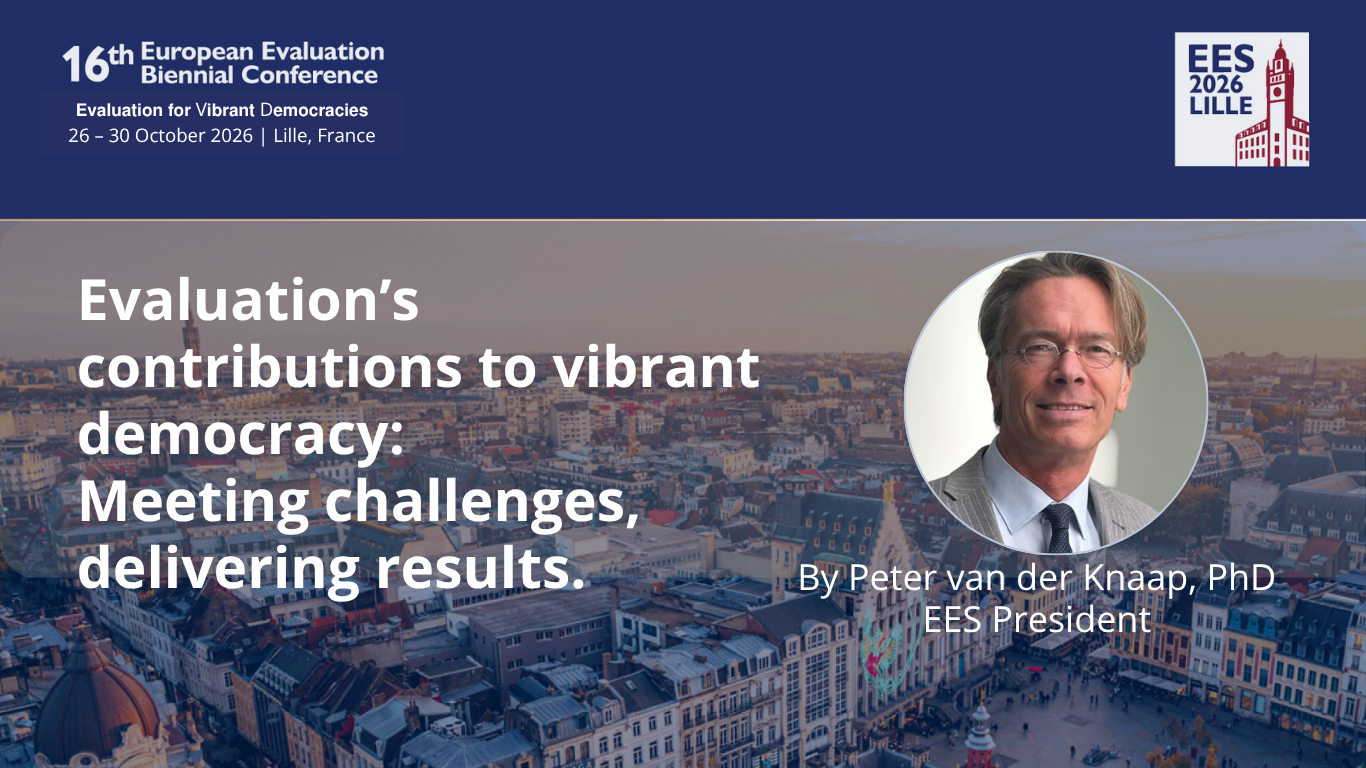
The theme of the 16th EES conference is ‘Evaluation for Vibrant Democracies’. Given the record number (!) of submissions to contribute to the congress with sessions and presentations, this theme clearly struck a chord in the European evaluation community…
Which is heartwarming, of course! At the same time, it is no real surprise: democracy is important for evaluation. A well-functioning democracy is, of course, a central aim in itself (and one for which people give their lives, at that). But it is also what we as evaluators need to do our work properly.
After all, what is the use of evaluation if we cannot ask the right questions or report our findings in a free and fair manner? If our aim is to help governments learn, what is the purpose of this learning without democracy? A more effective suppression of the people? And if we want to foster accountability and ‘speak truth to power’, who is it that will be held accountable if there is no true representation of the people?
At the same time, democracies are under pressure worldwide. According to the V-Dem Institute, less than 30% of the world’s population still lives in a democracy, down from 50% only decades before. In an important new report, European Commission’s Joint Research Centre (JRC) recently mapped out ten future challenges to democracy. Erosion of democratic norms – freedom of research and press – and erosion of citizen support for democracy are perhaps the most important ones, together with increasing doubt and deterioration of civil and political rights. David Mair, Policy Fellow in Cambridge and leading the Science for Democracy and Evidence-Informed Policymaking unit of JRC, stresses that democracy depends on a certain degree of shared reality. Reliable evaluation research can help in this respect.
But what do we actually understand by ‘democracy’? What is its purpose, and to which functions of democratic governance can evaluation really contribute?
A distinction that is helpful is that between representative democracy and liberal democracy. A representative democracy is, simply put, a form of government in which the population of a country, region, or municipality freely elects the public administration. This is also known as ‘electoral democracy’: residents have the right to vote (active suffrage) and the right to be elected (passive suffrage). Through elections, the majority—in Europe usually composed in a coalition—determines the representative body.
In this way, democracy enables citizens not only to be represented, but also to elect or have appointed administrators. Conversely, these administrators are accountable to the representative body: parliament or, for example, a municipal council.
A characteristic of an electoral democracy is that it is ‘lay rule’: every citizen has the right to vote and to be elected (although, as Mark Bovens points out, well-educated people tend to be overrepresented). The combination of administrators elected in free elections who are accountable to a representative body ensures that the policy of democratically elected governments reflects the will of the majority of the people.
A disadvantage of this is that the majority can impose its will on the minority – or on minorities. When such an all-powerful majority thereby exceeds the boundaries of law and reason, we can, following De Tocqueville, speak of ‘the tyranny of the majority’. For this reason, in the broader definition of liberal democracy, guarantees for civil liberties and rights are also linked to the representative functions of elected administrators.
This is also known as the ‘democratic rule of law’. The principle behind this is that majority decisions must not lead to a loss of respect for the freedoms and rights of minorities. Examples include freedom of religion, freedom of assembly, and freedom of expression (including academic freedom and press freedom).
To ensure this, certain safeguards or checks and balances are linked to the electoral principle. These are organized in independent institutions, often staffed by unelected officials appointed on the basis of expertise. Examples include Councils of State, the judiciary, Ombudsmen, Courts of Audit, as well as independent evaluators (note the capital letters).
The functions of democracy in our societies can be effectively described along these lines of electoral and liberal definitions. Representation, accountability, and legitimacy are strongly linked to the electoral definition. The constitutional safeguards of democracy encompass the protection of rights and freedoms, legal certainty and justice, and, as an extension of this, the settlement of disputes and conflicts.
In addition, there are functions linked to both the electoral and liberal interpretations of democracy. These are participation and policymaking. In participation, citizens have the opportunity to take part in political processes: not only elections, but also, for example, submitting petitions and engaging in public debate. This participation ensures active involvement in the design or modification of laws and policies. Policymaking concerns ensuring that the interests and needs of population groups are accurately reflected in laws and policies. It also relates to learning and improving policy designs and/or implementation.
The good news? Evaluation can contribute to all these facets by systematically assessing their quality and pointing out possible improvements. How extensive is political participation in a country, for instance, and how free and fair are elections? How truly independent are institutions such as ombudsmen or audit offices, and is their work being effectively utilized in practice? To what extent are the political freedoms and rights of citizens respected? What is the state of academic freedom and press freedom in a country?
The work of Elena Korosteleva is an example of the important work that is being done in this domain. I look forward to her book on ‘Democracy Support in an Age of Complexity’, which will be published later this year. However, in development cooperation too, evaluating democracy support is an established function of policy evaluation, albeit with significant challenges regarding definitions and attribution. In Lille, you can expect top scholars and colleagues from renowned institutions like DEval in Lille to share their experience in how to best navigate these.
But while mapping and assessing the ‘profit and loss account’ of measures to support democratic quality is an important function, evaluation can also contribute more directly to the quality and ‘resilience’ of democracy in Europe itself.
Of the main challenges described by the European Commission’s JRC, I believe our work can help with at least four. First and foremost, we can help to re-build citizen support for democracy by contributing to the effectiveness and even success of policy programmes. But also by pointing out what does not work and, which negative side-effects may outweigh benefits and, in this way, helping to stop wasting public money.
Second, the participatory and responsive methods ‘arsenal’ of evaluation can help to address the emergence and sometimes widening representation gaps in our societies. With the help of these methods, we may even help policy-makers to benefit from the – as the JRC calls it – the ‘often unfulfilled potential of deliberative and participatory processes’.
Thirdly, where evidence on successful interventions exists, evaluation can help to decrease doubt and to build confidence. So far, the blessings of Artificial Intelligence or AI are mixed: as Mhairi Aitken and her colleagues at the Alan Turing Institute put it, setting this transformative technology on the right path for both citizens and wider society will demand ‘well-informed, visionary policy-making and diligent anticipatory reflection’. At the same time, deliberately taking a learning perspective will help to take responsibility – and accountability – for facing ‘wicked problems’ where proven solutions and consensus are scarce. It is here, especially, that experimentation and more qualitative evaluation methods will be useful.
Finally, both ex ante and ex post evaluation, politicians can be helped to look into the future with the long-term vision that is needed to address global challenges, including climate change and environmental issues, geo-political and economic threats posed by ‘system rivals’, and fairness across social groups and generations.
So, if you ask me: evaluation definitely deserves a firm place on the agenda to innovate and revitalise democracy in Europe and beyond. In fact, it works! As Arturo Bris eloquently points out in his latest book ‘Super Europe’ it was through democratic deliberation and the use of knowledge that Europe has been able to achieve high living standards and a commitment to sustainability and human rights: ‘Europe remains one of the best places on Earth to live, work, and raise a family’. You only need to take a look at countries that score both high on the maturity of their evaluation function and quality of life indexes. There are many European nations in these Top 10’s: Denmark, Switzerland, Finland, Norway, Germany, the Low Countries…
Is everything perfect? Well, obviously not. We are faced by many and often difficult problems, requiring the difficult task of changing entire systems, as Philippe van den Broek rightly argues. But when done right, evaluation can help to ‘embrace complexity’ and to help citizens to meaningfully participate in political processes and public debate.
Evaluation knowledge and ways to engage sometimes unheard and dissent voices can contribute to an active involvement of people in shaping public policies and laws. Evaluation research leads to more transparency, sheds light on the results of what government is trying to achieve, and, in the process, helps accountability and policy-oriented learning.
So let’s go to Lille!
Bio: Dr. Peter van der Knaap is director of IOB, the independent Evaluation Directorate of the Netherlands Ministry of Foreign Affairs, and president of the European Evaluation Society (EES). Prior to this, he was director of SWOV Road Safety Research Institute, director of the Performance Audit Directorate of the Netherlands Court of Audit, and Head of Evaluation Research with the Netherlands Ministry of Finance. Van der Knaap also worked at Erasmus University Rotterdam where he earned his PhD with an analysis of the impact of policy evaluation in European Union structural policy. His lifelong fascination with evaluation has led to articles and books, on evaluation in general (in Dutch) and on positive evaluation (in English). He was president of the Dutch Evaluation Society Vide from 2016 until 2022 and is member of the Editorial Advisory Board of ‘Evaluation’.